Utility Locating and Risk Mitigation for Power Generation & Distribution Projects
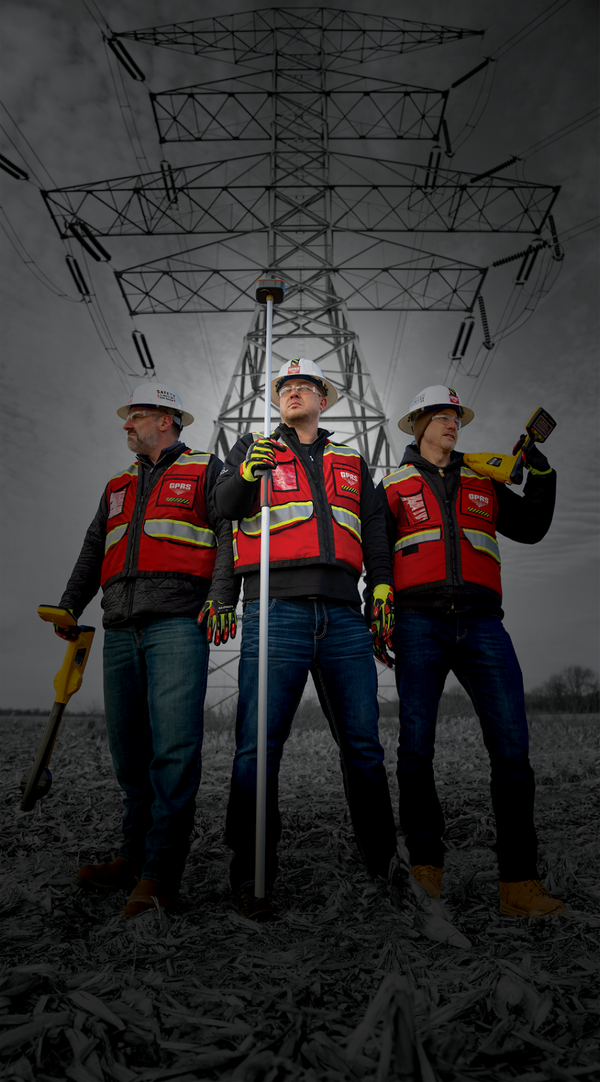
GPRS provides complete above and below-ground site visualization for the power industry. Learn more about our services here.
If you own or manage nuclear, natural gas, coal, hydroelectric, solar, wind, and hybrid generation assets, not knowing what’s under your site is not a minor field issue, it is a serious operational risk. The U.S. electric power industry spans fossil fuels, renewables, and everything in between, and each energy source relies on buried infrastructure to produce and/or distribute power. In fact, updating the current U.S. energy grid to most effectively deliver power from sources other than fossil fuels has been among the biggest challenges facing utility owners/operators.
Power generation and distribution facilities that could be impacted by blind excavation include electric feeders, communications, water, sewer, drainage, grounding, process piping, and control systems, according to data from the U.S. Energy Information Administration. When records are incomplete or outdated, any excavation, drilling, trenching, or foundation work can put safety, reliability, and capital execution at risk.
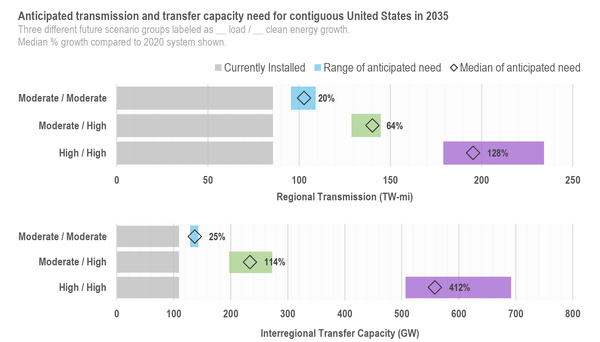
Chart from a 2023 Department of Energy National Energy Needs Study.png
The above chart from a 2023 Department of Energy National Energy Needs Study shows how much generation and distribution expansion is required to meet anticipated 2035 U.S. energy needs.
Why Utility Damages Cost Power Projects More Than You Think
The consequences of getting subsurface conditions wrong are material for a number of reasons, many of them regulatory, and all of them expensive. On any construction site, federal law requires contractors to determine the location of underground utilities before prior to excavation. State 811 “one call” centers are required to contact utility owners so that they can determine the exact location by safe and acceptable means when work approaches those utility installations. Failure to properly locate utilities prior to breaking ground is responsible for over 80% of all commercial underground utility strikes, according to the Common Ground Alliance’s 2024 DIRT Report.
In parallel, the economic impact of downtime caused by striking underground utilities is significant. The Oak Ridge National Laboratory reported that major power outages cost U.S. customers an average of more than $67 billion annually from 2018 through 2024, rising to $121 billion in 2024 alone. The National Renewable Energy Laboratory also notes that outage costs can include equipment damage, process interruption, lost output, spoiled materials, and reduced worker productivity.
The Alliance for Innovation and Infrastructure, a self-described energy industry think tank, breaks out the damages further, citing a 30:1 ratio between indirect and direct damages from utility strikes and interruptions; meaning that for every $1 lost in direct damages, another $30 is lost in down-time, wage loss, and “community losses.”
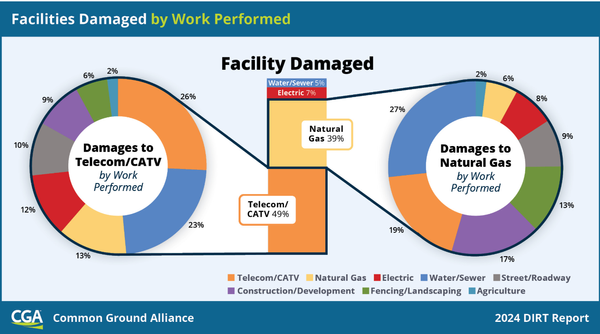
Excavation damages by type of utility or facility
Excavation damages by type of utility/facility damaged, according to the CGA’s 2024 report.
The damage-prevention data demonstrates utility strikes are an issue across all industries. However, the requirements of grid expansion mean that utility owners/operators experience heightened risk due to the sheer number of linear feet they must excavate. The CGA reported 196,977 unique damage events in 2024. Telecom and natural gas facilities were the most frequently damaged, and the top 10 root causes accounted for 85% of all reported damages. The CGA also states that utility work is the most common context in which damages occur, which is directly relevant to generation owners managing outage work, civil upgrades, underground tie-ins, and site modernization.
For power utility owners and operators, the management priorities are straightforward: protect personnel, prevent forced outages, preserve compliance, and keep projects on schedule and within budget. Those priorities apply across an energy portfolio, whether the work involves a security barrier, a duct bank extension, drainage improvements, a battery energy storage addition, a cooling-water modification, or a substation expansion. FHWA states that stronger subsurface utility engineering and geophysical investigation reduce unnecessary relocations, redesign, construction delays, contractor claims, and safety incidents. And the U.S. Department of Transportation backs them up.
Detail shot of the scope of work.png
A GPRS Case Study: Mitigating Risk for Nuclear Plant Security
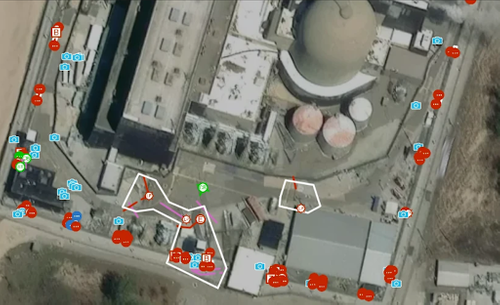
A recent GPRS project at a Lake Michigan power plant clearly illustrates the issue. A general contractor needed verified underground utility locations across dozens of targeted work areas to install a new security barrier. The work included
Preparing for the installation of augured fence posts
4 ft. x 4 ft. concrete block installations
Hydro-excavated footers
Locating any buried concrete at fence-post locations
GPRS performed utility locating and mapping for 30 block areas, two hydro-excavated footer areas, and four locations requiring buried-concrete verification, then delivered field markings and RTK-captured digital maps in CAD, PDF, KMZ, and SHP formats through SiteMap® (patent pending), the company’s proprietary GIS data management platform.
You can read the full case study here.
That specific project involved nuclear power generation risk mitigation, however, the underlying risk profile is not unique to nuclear energy. It is common across generation campuses, substations, peaker plants, renewables interconnections, and industrial power sites where private buried utilities may be dense, poorly documented, and operationally critical. GPRS specifically identifies power generation, transmission, substations, and distribution as environments where outdated records, duct banks, grounding grids, and other buried obstructions create material project risk.
How Risk Mitigation Transcends Power Generation Categories
Nuclear facilities do carry an additional layer of security and compliance complexity. NRC 10 CFR 73.55 requires licensees to maintain a site-specific physical protection program, including physical barriers, isolation zones, access controls, and protected and vital areas. The regulation also requires site-specific analysis of barriers and controlled access points. In practice, that means work around perimeter fencing and protected areas must be planned so construction does not compromise detection, delay, assessment, or access-control functions.
The same management principle applies outside the nuclear industry. The question for utility owners is not whether buried infrastructure exists; it is whether the project team has enough verified information to sequence work safely and avoid unplanned operational impact.
Calling 811 is necessary, but it is not sufficient for most complex generation campuses. The national 811 system requires public utility owners mark out the approximate location of buried utilities for participating facility owners before digging. The mandate does not include locating unregistered, aka, private utility lines. 65% of all utility lines located on most industrial and commercial sites are private/unregistered, and therefore not subject to an 811-ticket locate. Complex sites often require private utility locating to capture owner-operated infrastructure and obtain a more complete map, including depth information.
How Subsurface Due Diligence Protects Utility Owners and Managers
Risk control before field work starts: verified utility locations, documented clearances, and identification of private infrastructure reduce the likelihood of strikes, redesign, and emergency work. OSHA and FHWA both place clear emphasis on preplanning, utility identification, and safe verification as excavation approaches known installations.
Accurate data collection that project teams can act on: surface markings alone are not enough for engineering, outage planning, and contractor coordination. Digital utility maps, CAD files, KMZ layers, and GIS-based access support design review, work packaging, and constructability planning. SiteMap centralizes utility maps, CAD/BIM files, and related records in one platform to improve collaboration and reduce errors.
A workflow that supports operations, not just construction: the same verified data should remain useful after turnover for maintenance, emergency response, and future capital projects. SiteMap is positioned by GPRS as a single source of truth for above and below-ground infrastructure, not just a one-time project deliverable.
GPRS’ value to power utility owners and operators is in how we close the gap between one-call compliance and field-ready certainty. Our utility locating services combine ground penetrating radar and electromagnetic locating to identify buried public and private utilities and provide digital mapping outputs. The FHWA likewise identifies GPR as a major nondestructive evaluation tool for detecting, locating, and mapping subsurface utility lines, and notes that GPS-enabled GPR can support precise project maps.
And our commitment to Subsurface Investigation Methodology, the most rigorous training certification in the industry, combines multiple locating technologies, structured training, and standardized field methods to improve investigation quality and reduce error. For owners and operators, that matters because subsurface risk is rarely solved by a single tool. Congested corridors, nonmetallic lines, buried concrete, varying soil conditions, and incomplete records require a layered investigation approach and disciplined field interpretation.
How GPRS Supports Safer Execution for Power Generation Owners and Operators
Before design and excavation: GPRS can locate and map public and private buried utilities, identify buried concrete and obstructions, and provide clearances for excavation, drilling, boring, and foundation work. This supports early risk identification and better work packaging.
During construction and outage work: GPRS provides field markings with paint and flags, and all of our RTK-captured data, and digital deliverables are delivered via SiteMap to help EPCs, general contractors, operations teams, security personnel, and facility managers work from the same verified information.
After project delivery: SiteMap allows owners to retain utility maps, drawings, and related infrastructure records in a centralized GIS environment for future maintenance, modifications, and emergency response.
For utility owners and managers, the practical standard should be layered due diligence: call 811, verify what it marks, identify what it does not mark, expose utilities safely where required, and preserve the results in usable digital form. That is how owners reduce strike risk, protect uptime, control schedule exposure, and defend project budgets. GPRS supports that standard by providing a suite of above and below-ground visualization services, including private utility locating – surface marking, digital mapping – and a shared single source of truth that helps power generation owners and operators plan, build, and manage better.
What can we help you visualize?
Frequently Asked Questions
1) How does utility locating work?
Utility locating works by combining an existing as-built records review, federally mandated 811 ticket coordination for registered public utilities, and field detection to identify and map buried electric, gas, water, telecom, and other infrastructure before excavation begins.
For power plants, substations, and transmission/distribution sites, GPRS supplements One Call coverage by using ground penetrating radar (GPR) to detect both metallic and non-metallic targets and electromagnetic (EM) locating to trace conductive private/unregistered and public/registered lines with 99.8% accuracy. Then they mark-out and map their findings to reduce strike risk.
GPRS Project Managers adhere to the highest industry standard – Subsurface Investigation Methodology – which means that our processes and markings are standardized, and the deliverables can include field markings plus CADD and digital utility maps in PDF, KMZ, and SHP formats delivered through SiteMap®. Click here to learn more.
2) What is RTK positioning and how much more accurate is it than GPS?
RTK positioning stands for Real Time Kinematic Positioning and is a real-time GNSS correction method that uses data from a base station or correction network to improve satellite positioning from meter-level to potentially centimeter-level accuracy.
In typical field conditions, standard GPS/GNSS is often accurate within 2-8 ft., while RTK, in perfect conditions, can achieve roughly 1-2 cm. of accuracy, making it up to 244 times more accurate than standard GPS, depending on equipment, line-of-sight, and correction quality.
GPRS has integrated RTK positioning into our utility locating workflows as a standard operating protocol to geo-reference field data more precisely for mapping and reporting. Digital access to all deliverables is provided via our SiteMap GIS platform.
3) How does GPRS maintain 99.8% accuracy in utility locating and concrete scanning?
GPRS maintains 99.8% accuracy on utility locating and concrete scanning by outfitting and training Project Managers in multiple complementary technologies and a standardized subsurface investigation process (SIM) instead of relying on a single tool.
In practice, SIM-certified field team members compare their findings from GPR and EM locating, apply repeatable field methodology and processes, and use RTK-enabled geo-referencing, a process that has allowed GPRS to maintain a 99.8%+ accuracy rate across more than one million jobs.
The protocol is Subsurface Investigation Methodology (SIM). For concrete scanning, we further back up our deliverables with GPRS’ Green Box Guarantee.
4) What other services does GPRS provide for the power industry?
Beyond utility locating, GPRS supports the power industry with concrete scanning, 3D laser scanning and reality capture, NASSCO-certified CCTV pipe inspection, pinpoint leak detection, and updated as-built documentation.
GPRS’ nationwide Field Team of Project Managers helps power utility owners/operators and transmission/distribution teams document substations and plant infrastructure, inspect buried water, sewer, or process piping, detect leaks, and produce accurate models and drawings that reduce clashes, rework, and outage-related risk.
We can custom-design deliverables to mee your needs: 2D CADD drawings, 3D BIM models, meshes, point clouds, and more, WinCan CCTV reports (including video and PACP-coded defect classifications), PDF/KMZ/SHP utility maps, delivered via SiteMap for cloud-based infrastructure visualization and secure 24/7 data access.