
Subsurface Risk Checklist
A 10-Step Utility Strike Prevention Tool
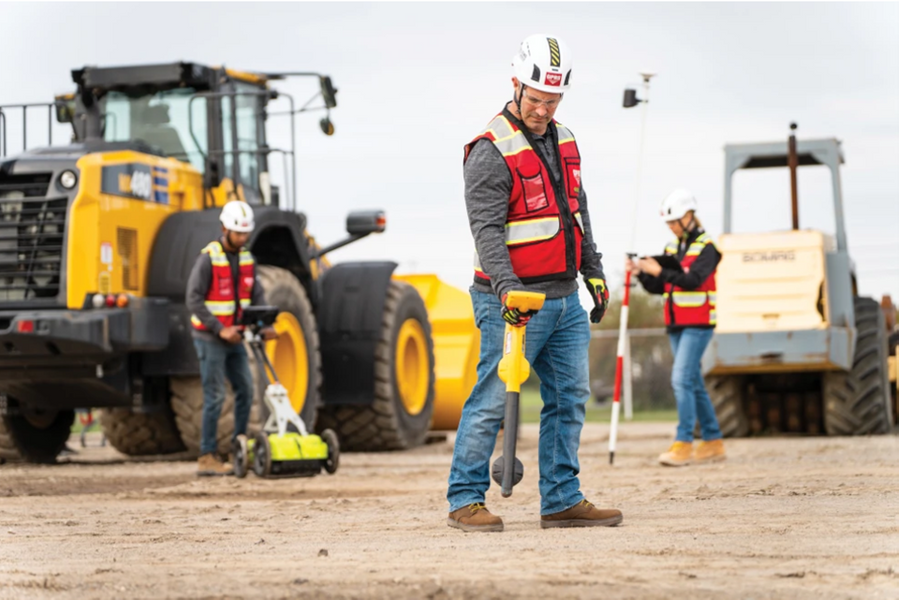
Knowing what’s underground before you dig could be the difference between a successful job and a huge headache. Private utility locating companies like GPRS can help you dig with confidence.
The following is an excerpt from The Subsurface Risk Checklist at GPRS. You can read the full article, here.
By Jen Britt, GPRS
March 2026
Before any drilling, excavation, or construction activity, understanding what lies beneath the surface is critical to preventing costly mistakes and ensuring site safety. Inaccurate utility maps, hidden utilities, unknown structures, and outdated as-builts can all create significant risk for your team. Use this checklist to identify project risks and get the field verified data required for confident, compliant decisions.
1. Documentation & Records
- Are utility maps or utility site plans available?
- Are utility maps or existing records current, accurate, and complete?
- Have abandoned or orphaned utilities been documented?
- Are there discrepancies between plans and field conditions?
2. Utility Locating & Verification
- Has utility locating (GPR, EM, or both) been performed?
- Have all public utilities been marked and verified?
- Have private utilities (electrical, telecom, water, gas, fiber) been located?
- Are depth, orientation, and material types known?
- Have conflicts, cross overs, and congested areas been identified?
3. Structural & Concrete Considerations
- Has concrete scanning identified rebar, conduit, PT cables, and sleeves?
- Are slab thickness and reinforcement patterns known?
- Are safe drilling/coring zones clearly marked?
4. Environmental & Soil Conditions
- Have potential contamination zones (soil, groundwater, vapor) been identified?
- Is a Conceptual Site Model (CSM) available or in development?
- Are groundwater levels, soil types, and subsurface pathways known?
5. Underground Storage Tanks (USTs) & Infrastructure
- Have active, abandoned, and orphaned USTs been located?
- Have stormwater, sewer, and drainage lines been mapped?
- Have VPI inspections been completed if needed?
- Are pipelines assessed for condition and structural integrity?
See the complete 10-part checklist and read the full article, here.
Click below to request a quote or schedule service with GPRS.
Frequently Asked Questions
1) How does utility locating work?
Utility locating works by combining an existing as-built records review, federally mandated 811 ticket coordination for registered public utilities, and field detection to identify and map buried electric, gas, water, telecom, and other infrastructure before excavation begins.
For power plants, substations, and transmission/distribution sites, GPRS supplements One Call coverage by using ground penetrating radar (GPR) to detect both metallic and non-metallic targets and electromagnetic (EM) locating to trace conductive private/unregistered and public/registered lines with 99.8% accuracy. Then they mark-out and map their findings to reduce strike risk.
GPRS Project Managers adhere to the highest industry standard – Subsurface Investigation Methodology – which means that our processes and markings are standardized, and the deliverables can include field markings plus CADD and digital utility maps in PDF, KMZ, and SHP formats delivered through SiteMap®. Click here to learn more.
2) What is RTK positioning and how much more accurate is it than GPS?
RTK positioning stands for Real Time Kinematic Positioning and is a real-time GNSS correction method that uses data from a base station or correction network to improve satellite positioning from meter-level to potentially centimeter-level accuracy.
In typical field conditions, standard GPS/GNSS is often accurate within 2-8 ft., while RTK, in perfect conditions, can achieve roughly 1-2 cm. of accuracy, making it up to 244 times more accurate than standard GPS, depending on equipment, line-of-sight, and correction quality.
GPRS has integrated RTK positioning into our utility locating workflows as a standard operating protocol to geo-reference field data more precisely for mapping and reporting. Digital access to all deliverables is provided via our SiteMap GIS platform.
3) How does GPRS maintain 99.8% accuracy in utility locating and concrete scanning?
GPRS maintains 99.8% accuracy on utility locating and concrete scanning by outfitting and training Project Managers in multiple complementary technologies and a standardized subsurface investigation process (SIM) instead of relying on a single tool.
In practice, SIM-certified field team members compare their findings from GPR and EM locating, apply repeatable field methodology and processes, and use RTK-enabled geo-referencing, a process that has allowed GPRS to maintain a 99.8%+ accuracy rate across more than one million jobs.
The protocol is Subsurface Investigation Methodology (SIM). For concrete scanning, we further back up our deliverables with GPRS’ Green Box Guarantee.
4) What other services does GPRS provide for the power industry?
Beyond utility locating, GPRS supports the power industry with concrete scanning, 3D laser scanning and reality capture, NASSCO-certified CCTV pipe inspection, pinpoint leak detection, and updated as-built documentation.
GPRS’ nationwide Field Team of Project Managers helps power utility owners/operators and transmission/distribution teams document substations and plant infrastructure, inspect buried water, sewer, or process piping, detect leaks, and produce accurate models and drawings that reduce clashes, rework, and outage-related risk.
We can custom-design deliverables to mee your needs: 2D CADD drawings, 3D BIM models, meshes, point clouds, and more, WinCan CCTV reports (including video and PACP-coded defect classifications), PDF/KMZ/SHP utility maps, delivered via SiteMap for cloud-based infrastructure visualization and secure 24/7 data access.